Just released: Another publication of special issue “Lifestyle, Diet, Wine and Health”
Following the first 2 congresses on “Lifestyle, Diet, Wine and Health”, in Toledo and Rome, a peer-reviewed special issue in Nutrients is being compiled.
Another manuscript has just been published (https://www.mdpi.com/2072-6643/18/12/2006 ) and more are to follow soon.
The main authors are two WIC experts: Prof. Attilio Giacosa (Italy) and Prof. Josep Masip (Spain).
Impact of moderate wine consumption on type 2 diabetes
Type 2 diabetes (T2D) is a prevalent disease worldwide that increases the risk of cardiovascular (CV) complications, disability and mortality. While excessive consumption of alcoholic beverages is harmful, the effects of moderate wine consumption remain debated. This narrative review aims to examine the impact of moderate wine consumption on type 2 diabetes (T2D), focusing on the role of wine within the broader Mediterranean dietary pattern. Specifically, this review addresses whether moderate wine consumption can modulate the risk of developing T2D and explores how and under what conditions patients with T2D may safely consume wine.
A literature search (2000–2025) was conducted across major databases. Nineteen studies were analysed, distinguishing, whenever feasible, general alcohol intake from moderate wine consumption patterns.
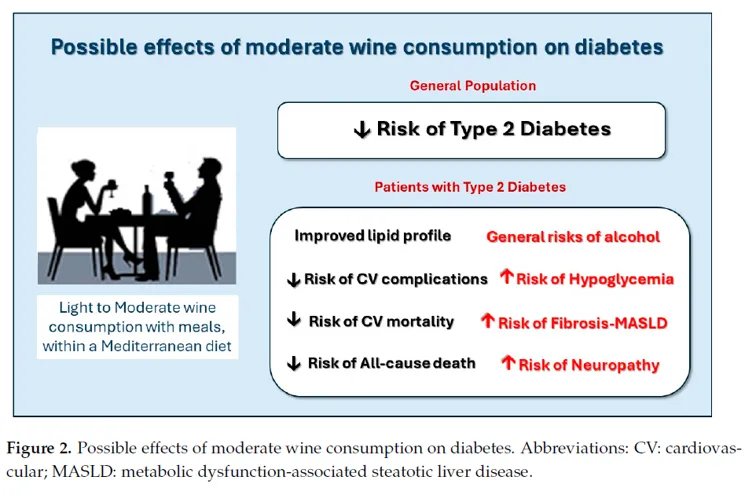
Main conclusions:
- Alcohol abuse is clearly linked to many serious health harms, such as increased risk of cardiovascular disease, cancer, digestive disease, infections, accidents, and violence.
- Evidence suggests an association between moderate wine consumption and the risk of developing T2D, with a J-shaped relationship, and reduced risk observed at low levels. This effect appears more pronounced with red wine, likely related to its higher polyphenol content, and when consumed with meals.
- In individuals with well-controlled diabetes, moderate wine intake may be associated with better lipid profiles, lower inflammation, improved glucose control, and possible renal and vascular benefits.
- The Mediterranean diet may amplify these associations, especially when wine is taken with meals.
The authors stress, however, that the evidence is mainly observational and not proof of causation. Moderate wine consumption should not be interpreted as a recommendation or target. The safest clinical interpretation, especially for patients with diabetes, is to keep intake of alcoholic beverages as low as possible and assess risks individually.
They conclude with guidelines for wine consumption in patients with T2D:
- If you have T2D do not start drinking if abstinent.
- If already drinking, preferably take wine in moderation (as low as possible), when T2D is well-controlled, and always with meals, following a healthy dietary pattern like Mediterranean-style, and after individualized clinical assessment. Avoid alcohol in vulnerable patients.
- Regularly monitor your blood sugar. Alcohol can cause a drop in blood sugar several hours after drinking, especially if you take antidiabetic medications. Avoid drinking in excess or on an empty stomach.
- Individual responses vary. Some patients with T2D must avoid alcohol consumption due to specific therapies or other concomitant diseases like neuropathy, liver disease, psychiatric disorders or addictions and alcohol-related vulnerability. For this reason, always talk to your doctors before drinking alcohol/wine and follow their therapeutic and behavioural recommendations.